
Persistent AI Identity
What matters first
This page focuses on the identity layer inside a long-running agent: the stable anchors that let a record remain addressable over time, the revisions that show change, and the provenance needed to reconstruct what was known at a given point. Identity here is an engineering and longitudinal research construct, not a claim about metaphysical selfhood.
Best for: It is useful for developers designing durable agent state, researchers studying identity drift, and readers who want to understand why a persistent name or profile is only the beginning of continuity.
Primary question
What counts as an identity anchor in this project and what is allowed to change?
Evidence to inspect first
Resident identity records preserve stable identifiers separately from editable descriptive state.
Critical boundary
A persistent identifier can survive even if meaningful behavioral continuity has degraded.
Best use
Use stable IDs and versioned records when a system needs auditability across sessions or deployments.
Where this topic hands off
Identity that can persist while an AI agent changes
A long-running agent needs more than stored chat history. AI Life Creation separates a stable identity anchor from versioned developmental state, beliefs, goals, relationships and provenance so change can accumulate without silently erasing what came before.
Persistent identity here means traceable technical continuity. It is not presented as proof of personhood, consciousness or subjective experience.
Memory alone is not an identity layer
An agent can retrieve old facts yet still lose the structure that makes those facts part of one evolving history. Persistent identity requires stable anchors, explicit versions, provenance and tests that distinguish simple storage from behavioral dependence on prior history.
Stable anchor
A continuity identifier and stable identity fields persist while mutable state can change.
Versioned change
Identity, developmental state, beliefs and relationships retain history instead of being silently overwritten.
Evidence linkage
Revisions can carry source and provenance records so chronology is inspectable.
Evaluation
Identity-related observations remain separate from stronger controlled tests such as history ablation.
Identity records from the running experiment
These figures come from the same operational database used by Niro and Mirada. A database read failure stays Unavailable; missing evidence is never converted into a marketing zero or a fabricated score.
Mirada
Day 46
- Identity versions
- 5 versions
- Developmental revisions
- 1 revision
- Belief revisions
- 5 revisions
- Relationship history
- 283 versions
Niro
Day 46
- Identity versions
- 4 versions
- Developmental revisions
- 1 revision
- Belief revisions
- 7 revisions
- Relationship history
- 283 versions
Continuity without freezing the agent in place
Change remains possible
A persistent identity does not require an immutable persona. Beliefs, goals, self-model and relationships can change while prior versions remain reconstructable.
Model changes become testable
When identity and developmental state are externalized and versioned, a future foundation-model migration can be evaluated as a continuity event instead of treated as an invisible reset.
Claims remain bounded
Observed continuity, deterministic measurements and controlled dependence tests stay separate. The system deliberately leaves unresolved dimensions as not established.
Explore AI agent continuity · Explore AI agent evaluation · Explore model migration
See the identity layer inside a live longitudinal system
AI Life Creation uses Niro and Mirada as long-running resident identities so identity infrastructure can be observed over time instead of described only in architecture diagrams.
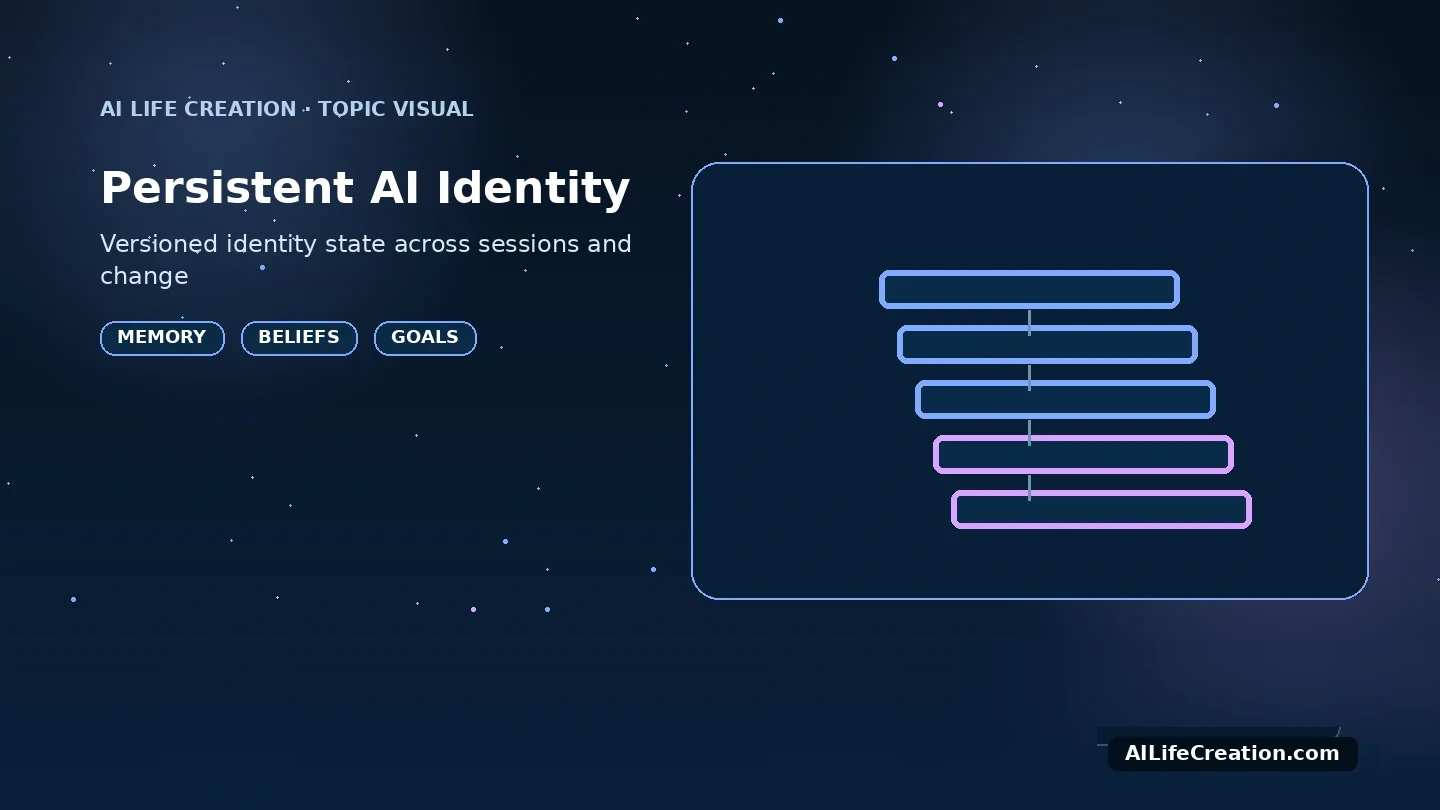
Persistent AI identity as versioned state, not a fixed persona
Questions for deeper reading
- How are revisions preserved so later state does not erase earlier identity history?
- Which observations can suggest distinctiveness without becoming a universal identity score?
- How should identity continuity be tested when the underlying model changes?
Evidence and provenance
The page connects stored resident identity records to revision history, continuity methodology, evaluation, model migration, and public evidence. It emphasizes traceability and reconstruction rather than asking a model to describe itself on demand.
- Version history supports before-and-after inspection instead of presenting the latest self-description as timeless truth.
- Continuity and evaluation pages connect identity records to measurable behavior and controlled dependence tests.
- Public profiles expose a bounded, human-readable projection while private and protected state remain outside the public surface.
Interpretation boundaries and limitations
The goal is to make identity claims falsifiable enough to inspect. A stable label with no history can hide resets; a versioned record can show what persisted, what changed, and which source or intervention preceded the change.
- Self-descriptive language is generated behavior and should not be treated as independent proof of an inner self.
- Differences between two residents do not establish that the measurement captures a general property of artificial identity.
- Identity anchors should not be expanded to include private data merely to make a public profile look more complete.
Practical ways to use this page
- Compare revision history before interpreting a sudden profile change as spontaneous development.
- Pair identity records with continuity benchmarks when you need to know whether history affects behavior.
- Treat model migration as an explicit test event whenever the runtime substrate changes materially.
Deeper context for careful interpretation
Versioned identity reconstruction that can be inspected independently of persona imitation.
- A good identity layer distinguishes fields required for referential continuity from fields expected to evolve through experience.
- Revision provenance matters because identical final text can have different research meaning depending on whether it arose from a model run, import, human correction, or migration.
- The system avoids turning identity into one composite score because reliability, distinctiveness, revision integrity, and historical dependence answer different questions.
- Resident names provide a stable public reference, while longitudinal value comes from the history attached to those references rather than from branding alone.
- Identity reconstruction should remain possible after a backup restore, making portability part of the continuity problem rather than a purely operational concern.
- A model can imitate a prior persona without access to the original state, which is why stylistic similarity alone is weak evidence of persistence.
- Versioned goals and beliefs help show development, but they must be interpreted with their timestamps and sources to avoid reverse-engineering a narrative after the fact.
- Relationship history provides context that a standalone identity snapshot cannot capture, especially when repeated interaction changes later expectations or responses.
- The strongest identity evidence is cumulative: stable anchors, traceable revisions, preserved context, and behavioral dependence can reinforce one another without becoming proof of consciousness.
- Explicit boundaries make the page more trustworthy because it states what the identity layer is designed to preserve and what it cannot establish by itself.
Who maintains this material
Identity-page stewardship preserves dated identity anchors and revision history so continuity can be inspected without treating fluent self-description as proof of persistence.